
.png)
Human Learning Systems at Wellbeing Teams: Values-Based Recruitment in Practice
It was 9.45 and I was holding my breath. It was our first ever values-based recruitment workshop, in a chilly church hall in Lytham St Annes on a Thursday morning in November. There were 15 minutes to go. We had invited ten people to join the workshop, and so far our recruitment team of five (two were helping us as ‘experts by experience’) outnumbered candidates by over 2:1.
There is a cynical joke amongst home care managers, that if you can breathe you can have the job of being a carer. It reflects the continuous cycle of recruitment to cover shifts, and the churn in the sector of 70%. This means seven out of ten carers have worked in other home care companies, and are constantly in search of a better working life.
In traditional home care, recruitment is through a 30 minute interview, with up to 80% of people not showing. At the same time that we were recruiting the first Wellbeing Team in our partner home care organisation, the Registered Manager Susan, was doing her own recruitment drive for the rest of the organisation. The day before she had scheduled 6 interviews and only one person had turned up.
I had high hopes that our experience would be different, but at 9.50 it was not looking good. I went to the front of the church hall hoping to see people arriving or on the street lost, and looking for the building. I was like a greeter at a Disney Store.
Breathe. At 10 am we had nine applicants, only one had worked in home care before, and we had taken a call from the disappointed tenth person who had become unwell overnight and asked if he could come to the next one instead. How did we persuade nine people to show up for a three hour workshop, while Susan could only persuade one out of six people to show up for a 30 minute interview?
In 2018, after decades of working as a consultant, I got skin in the game and decided to set up Wellbeing Teams as a provider, registered with the regulator CQC, with myself as the Registered Manager and Responsible Individual. Wellbeing Teams are small, neighbourhood, self-managed teams, supporting people to live well at home and be part of their community.
I was on a steep learning curve about recruitment.
I don’t have any background, or qualifications in HR or recruitment. I was once part of a panel for a charity and that is the extent of my recruitment experience. In Wellbeing Teams we don’t have an HR or recruitment department. This made winning The Guardian Public Service Award for HR and Recruitment both a joy and kind of ironic.
I remember sitting with my colleague Michelle, in my basement office with a blank piece of paper on the large pinboard, with our purpose and values written in black pen at the top. We wanted to design a process that reflected our values and found great colleagues who are a good fit for us and the work - from their perspective and ours. We had decided to intentionally look for people from outside health and care, although we did not exclude people with experience. We believed that we could teach people the skills that they needed, and that people with existing experience of home care would find it harder to unlearn traditional practices like phoning the office to speak to the manager. Overall, 10% of our teams across the country came from home care. We imagined that if people had experience with customers or the public in some way, and their values aligned with ours, and they were curious about self-management, then this would be a good place to start. I had no idea, at that stage, how important recruitment would be to Wellbeing Teams, and to sleep pattern.
There were many things that kept me awake at night as a new Registered Manager and business owner. Recruitment was one of them. I would lie awake wondering how many people would respond to our Facebook advert, whether we had left enough time between the adverts and the recruitment workshop, and was it too bold not to use job boards like Indeed at all?
The process that we designed, experimented with, and kept (keep!) adapting, looks different from traditional HR-led recruitment in several ways. Before I explain the ways we implement values-based recruitment, let's get clear about what we mean by this. My go-to person around values, and one of the National Advisors for Wellbeing Teams, is Jackie Lefevre, so I will pick up the story with her. When I talk about values-based recruitment I am thinking about it in two directions. Are we demonstrating our values through the recruitment process? And does our recruitment process intentionally attract people whose values align with ours?
You are doing values-based recruitment already - but are you doing it deliberately?
The research around values-based recruitment is compelling. It tells us that it reduces employee turnover and increases employee satisfaction and performance, as well as increasing trust and cooperation between team members. It has become a buzz phrase in care, however, and now most organisations do their version of values-based recruitment. Jackie argues that every organisation does values-based recruitment. The question is whether it is conscious or not.
This is what Jackie says: “The things you write and say, how you express them and sequence them all matters. The shortlist criteria you use, the structure of the interview questions, what you give candidates marks for and what you don’t give them marks for – all this is driven by an underlying set of values. Whether intended or not certain values are coming through. You are doing values-based recruitment – just not deliberately.”
Values are an expression of what matters most to a person, a group, an organisation. Values shape our sense of the world, how things work and what is ‘like’ or ‘not like’ us.
In recruitment two sets of values are at work. The values of the recruiting organisation (or a combination of the values of the organisation that wants to recruit and the values of the recruitment consultancy being used) and the values of the potential candidate.
Great hires take place when the values of the employing organisation and the values of the individual align and resonate with one another. This is not about looking for a ‘match’. There is no such thing as the ‘right’ set of values. This is not about taking a values shaped cookie cutter to the labour market seeking people who fit that shape.
Consciously values-based recruitment is about finding the words, processes and activities which both embody the uniqueness of the employing organisation, and put flesh on the bones of a candidate’s sense of what the job might be like in real life.
Jackie said that she recently worked with an organisation who had ‘creativity’ as one of their values. They talked me through their recruitment process, and it was standard stuff. I asked, “How does your creativity value show up in the recruitment process?”
The penny dropped and they agreed that it didn’t. The value most evident was efficiency, there was nothing creative visible. How many creatives do you know that would be attracted by an efficient process? Wellbeing Teams values are compassion, responsibility, collaboration, curiosity, creativity and flourishing. We wanted to both demonstrate these values and recruit to them. This meant that we needed to consider the purpose of recruitment, who is involved, how recruitment takes place and what is seen as success.
Purpose, people and process in recruitment
Purpose. I know this sounds obvious because the purpose of recruitment is to find the best person to fill a vacancy. The nuance here is what we mean by the best person. We think about mutual fit. We want you to decide if we are the right fit for you, as well as whether you are the right fit for us. Our process is designed so that you rule us out first, if you decide we are not a good fit for you. This saves time and energy for everyone.
Who. Usually this is the role of the HR team, with the local manager, or it might be outsourced. We think that everyone is a recruiter, and we pay attention to that (not in a typical ‘bonus if you refer a friend’ way). In each team there is someone who has a specific role around recruitment. Co-production matters to us, whether we are working with an individual or family to recruit their team, or recruiting a team to support people in a local neighbourhood.
How. Standard recruitment is one or more interviews. We want to see how people interact together as team work is crucial. We want to see how people bring their whole selves to the recruitment experience so we meet them for a few hours.
Success. A good recruitment process is seen as quick and efficient. Quick isn't always efficient if it delivers people who don’t fit the organisation. What looks efficient may lead to low retention and poor performance, quite apart from recruiting people whose values do not align with the organisation. You are likely to spend more time with your work colleagues than your family, and your health and mental health will be significantly impacted by your work. We invite people to invest time and energy in our recruitment process (whilst still being efficient).
I know that there are some excellent recruitment processes, in particular where provider organisations have thought deeply about how to involve people who use the service, reflected on values, and carefully considered the experience for the candidates. My comments above reflect what is standard and typical of recruitment in general.
From when we started with our blank paper on the pinboard, to now supporting a local authority to recruit their first wellbeing teams in Extra Care, there are a range of elements that we are using and testing that relate to purpose. Here they are in summary, and how they may differ from standard recruitment in relation to the purpose of recruitment, who is involved, how recruitment takes place and what is seen as success.
Here is a summary of the approach that we have taken to recruitment in Wellbeing Teams.
|
Moving From |
Towards |
||
|
Purpose
|
Why |
Finding the best candidate for the job. Therefore providing Information about the job, tasks and responsibilities. |
Mutual Fit. Approaching recruitment based on the idea of mutual fit. This means providing a range of ways to help prospective candidates get a good insight into the role and us as an organisation, and decide whether we are for them first. |
|
Values - attracting |
Recruitment based on qualifications and experience. |
Values-based. Recruiting based on values and characteristics and only qualifications if absolutely required to do the role and cannot be learned once in the role. |
|
|
Values - demonstrating |
Recruitment design based on efficiency |
Demonstrate the organisation's values. Recruitment design based on demonstrating the values of the organisation - walking the talk. |
|
|
Who
|
Role |
The HR team or another dedicated team is responsible for recruitment (and this may be outsourced) |
Everyone is a recruiter, and there are a range of people with recruitment in their roles alongside other roles. We have Co-Production Partners working alongside us in recruitment. |
|
Decision-making |
Recruitment decisions made by the HR team |
Co-production. Recruitment decisions made by/with the team/manager and Co-production partners(experts by experience). |
|
|
How
|
Finding people |
Thinking about who to recruit is based on experience and qualifications and where people with that experience/qualifications will be looking for a work. |
Marketing approach. Deciding who to look for based on values and then using a marketing approach to reaching potential candidates based around personas. |
|
Process |
Interviews |
Groups. Candidates are given opportunities to demonstrate who they are, and shine, in a range of ways, for example workshops. |
|
|
Success
|
Candidate experience |
Overall candidate to colleague experience is not usually considered. Recruitment, induction and probation are handled by different departments |
Continuity. Recruitment, induction and probation are led by the same people offering continuity of experience |
|
Time |
Success is seen as making the recruitment as efficient as possible |
Invite people to invest time and energy. We ask people to prepare before a workshop, and invest 2 - 3 hours with us. |
|
|
Review and learning |
Recruitment process evaluated by the HR or recruitment team based on metrics |
Learn from everyone involved. Everyone involved in recruitment, including candidates (successful and unsuccessful), are involved in reviewing the process and identifying what to try next, what experiment is needed to test out ideas for improvement. |
Value-based recruitment in practice
The challenge was to consciously connect to our values and design a recruitment process where every word, every stage, every sequence, every interaction is designed to make those values shine through? We want to both attract people who share our values and demonstrate our values at the same time. Here are some examples of how each of our values is reflected in the process, and how we try to attract people who reflect our values.
|
Value |
How we demonstrate this value through the recruitment process |
How we identify people who align with this value |
|
Compassion |
|
We look for compassion in:
|
|
Responsibility |
|
|
|
Collaboration |
|
|
|
Curiosity |
|
|
|
Creativity |
|
|
|
Flourishing |
|
|
In Human Learning Systems terms, our approach puts Human and Learning at the heart of recruitment. Increasingly, by sharing our insights with other partners across the system we’re bringing more of the Systems dimension to recruitment at Wellbeing Teams too.
Being Human to one another
We are looking for great humans, and being human to one another is the essence of care and also of self-management. We intentionally recruited from outside of health and care, and thought hard about who we were looking for and where we could find them, whilst still attending to equality and diversity. We invited people to spend time on this big decision - the work you do and who you do it with. We think differently about power in recruitment and we see it as a question of mutual fit. We don’t ask about work history at the beginning, we ask people to share who they are, through a one-page profile. Instead of an interview, we designed a recruitment workshop that enables people to share their strengths, and learn more about the work we do.
1. Recruiting from outside of health and care
Our vision for Wellbeing Teams, and our values, required us to find great people who have compassionate hearts, take responsibility for themselves and their work, and are open to self-management. I thought that if we could find people who aligned with our values, then we could teach them what they needed to know to deliver great care within a service regulated by the Care Quality Commission (CQC). I believed that it would be harder for people already working in care to unlearn traditional ways of working, than for us to find great people and support them to learn how to provide support wrapped around each individual.
This was practically unheard of at the time. In our first recruitment of Wellbeing Workers in Wigan, our team included a hairdresser, a van driver, a student and a shop assistant who wanted to do work that matters, supporting people and were open to changing their career.
2. Treating candidates as individuals - using a marketing approach to make recruitment as personal as possible
We thought about who we wanted to attract and created what Seth Godin calls ‘psychographics’. This means thinking about what people might think and feel about care work, what their fears might be, what they might hope for. It is the application of empathy to recruitment. We also looked at where people might go in the community, what groups and associations they might be part of, and where they might see fliers or leaflets. We wanted to attract parents who were thinking about coming back to work and, for example, made sure that the times of our workshops fitted in with school runs.
We designed different Facebook adverts to specifically attract people that we were looking for. When we used Indeed, we posted in beauty, customer services, and bar work, starting with ‘You may never have considered a career in care, but as a beautician, you are probably someone who cares about your clients and how they look and feel about themselves. Wellbeing Teams could be your next career move … read on to find out more’.
Here is a draft facebook post in our recent recruitment for Camden’s teams in Extra Care.

3. Inviting people to invest time in finding out whether this role is for them
If you were applying for a high status senior leadership role, you would expect to dedicate a day to attending various assessment centres and interviews. In our view, supporting people to live well at home should be high status, and it requires the same attention and time given to recruitment. We also believed that, if candidates were to give up half a day to attend a recruitment workshop, then we would only get people who really wanted the role. Some of the ‘no-shows’ in typical career recruitment (where people do not turn up for an interview) are a result of them having to demonstrate that they are actively looking for work, so they agree on interviews without any intention to show up. People also apply for a number of jobs at the same time and may accept another role without withdrawing from other interviews. By asking for a 3-hour commitment to a workshop that requires people to prepare, we demonstrated a high expectation of people and avoided these behaviours. This goes against the common posture in home care of ‘make it as easy as possible for people’.
4. Supporting candidates to bring their whole self to the recruitment process and focussing on strengths
Instead of the ‘person specification’ we use a different format called ‘Could this be you?’. This describes the strengths and attributes that we are looking for, what is likely to matter to the person we are looking for, and the support that we will offer to help people be their best at work.
Traditional recruitment starts with a CV or detailed application form that gathers CV type information. There is a thriving business in CV preparation, and you can pay others to create one for you. As we wanted people to bring their whole self, we asked applicants to create a one-page profile instead of a CV. Rather than learning about a work history, we wanted people to share with us who they are and what matters to them, as well as what support they need to be at their best at work. We shared our own one-page profiles, as part of the application pack, and gave people a template and instructions. Typically, you would know nothing about who is interviewing you, other than their name and role. In values-based recruitment, we show up as humans, sharing what matters to us and the support we need to be at our best. This means we meet people human to human.
Below is my one-page profile that would be shared with candidates when I am part of the recruitment team:

5. Thinking differently about power in the recruitment process - this is a mutual question of ‘fit’
Usually in a recruitment process the question is ‘Are you good enough to work here?’ We frame this differently - as a matter of fit. Are you the right fit for us? Are we the right fit for you? The first interaction, person to person, is designed to help the candidate answer the question ‘Is this organisation and role right for me?’ before we learn about them. We want them to be sure that this is a place where they could thrive, before we see if they could be a good fit for us. We demonstrate this different way of thinking about power at the end, when the group has an opportunity to work together in threes or fours to ask me, the Founder, or the Wellbeing Leader questions in a reverse interview.
6. Focus on relationships, empathy and building trust in the recruitment workshop
In the recruitment workshop, the exercises and tasks are designed to help people shine, not to catch them out. People report back how much it put them at ease, that it did not feel anything like an interview but was actually fun and gave them a valuable new experience. We watch people swapping telephone numbers with other people at the end, to keep in touch. This is a human process. Our exercises and tasks demonstrate our focus on relationships, empathy and trust - from sharing hand massage with each other, to talking about failures and learning, and giving feedback.
7. Take a whole team and system approach - working with team members, and Co-Production Partners
We were delighted to win the Guardian Public Services Award for Recruitment and HR. However we are sure to be the only recipient who does not have an HR department or anyone with that role title. Recruitment is done by the team, supported by the Wellbeing Leader (who holds the responsibility for ensuring we are compliant with recruitment law) and our Co-Production Partners (people with lived experience). When we have worked with families, the family would be involved throughout the process as much or as little as they want to be. We make sure everyone is clear about decision-making within the process through a decision-making agreement. Where we are recruiting a team to support a larger number of people, we involve Co-Production Partners. They are volunteers who either receive support from us or who are family members. They have a clear role within the process and are co-decision makers. In each team there is a team member with the role of Recruitment, and they work with the Wellbeing Leader and Co-Production Partners. This enables us to have the whole system in the room for recruitment. As part of the workshop each person explains their role in the process and system.
Learning and Recruitment
In our recruitment we wanted to explore different ways to learn about people, and keep learning and developing in our recruitment practice. We are looking for people with a growth mindset who are curious and want to keep learning and developing, and people who can use their head, heart and hands in their work.
Traditional recruitment relies on people talking about what they have done in the past, and how they would respond to specific situations. I think that there are significant limitations to this:
- People can sense or learn the ‘right things to say’
- You cannot see how people react or respond in a group
- You cannot see how people respond to people with lived experience
- You don’t see how people work with their hands - just their head
- 30 minutes is a short time to learn how people would respond to a range of situations
We decided to use a workshop approach instead of an interview and invited Ali Gardner, a leader in social pedagogy to help us think about the best ways to do this. Using ‘head, heart and hands’ are central to relational practice in social pedagogy.
As well as values, we looked at the competencies and tasks that we were expecting from Wellbeing Workers. One was to provide a compassionate touch in personal care, another was to learn about what matters to people through conversation instead of interview, another was to be reflective about what they were learning. We tried to design elements of the recruitment process that would enable us to see people doing this.
We have two sets of cards that we used in the workshop. One set was focussed on the head. We were not expecting people to have any experience of care, but we wanted to know how they would use their heads, their common sense to address some of the common challenges that team members could experience. This was a set of ‘What if?’ cards based on realistic scenarios. We developed these by:
- Asking all twelve local home care providers in Wigan to share the issues/questions that came through to their ‘on call’ system. This meant that they were the issues that people were unsure how to deal with, or needed reassurance. We checked that we had these covered in our What if cards, and added to or amended questions.
- Our personal experiences. Michelle (Wellbeing Leader) and I had both covered multiple shifts and shadowed other team members. On one occasion Michelle locked herself out of the person's home and there was no way to get back in. One of our ‘What if’ cards asked people what they would do in that situation.
- Issues that came through ‘help desk’ or were posted on Slack by team members if they had a concern.
- Learning from incidents and complaints.
|
Competence we were looking for |
Demonstrating this in the recruitment process |
|---|---|
|
Following instructions |
|
|
Compassionate Touch |
|
|
Conversations to learn about the person (and share) |
|
|
Reflection - being able to describe what you have learned |
|
|
Giving feedback |
|
|
Working with other team members in a group |
|
Learning together and experiments
In our recruitment process we use a doughnut. Originally developed by Charles Handy, this person-centred practice describes what is core to a role or task, and where people can use their creativity and judgement.

The core components ensure that we are reflecting our values (and employment law) which must not be altered. This would include, for example, working with a Co-production partner or someone with lived experience. In the next section of the doughnut is where you can use creativity and judgement, this is where we would expect there to be experiments, and not all of them will work, and that's OK.
At the end of each recruitment process a core requirement is that the people involved, the recruitment team, complete another person-centred thinking practice called the ‘Four Plus One’. This is a reflection process that asks four questions looking back, plus one looking forward:
- What did we try?
- What did we learn?
- What were we pleased about?
- What were we concerned about?
- Based on this, what do we want to do or try next?
This information is put alongside information from an online survey. After people have completed the workshop, and before they get their feedback on the outcome of it, we ask people to complete a survey via SurveyMonkey. This goes through each of the elements of the recruitment process, and asks them to give us a score, and specifically tell us what worked, what did not work, and asks for a specific instruction about how we can improve. This also gives us an overall score for each recruitment drive, and we can see if there are any differences across different teams and learn from that. We are seeking to demonstrate our value of curiosity about how we did, and continuous learning.
We hope that during the next recruitment process, we are testing out something new, an experiment, or some insight that came from the previous process, so that we can keep learning and developing. In the last recruitment process we used Zoom instead of the face-to-face due to Covid restrictions.
Conclusion
That chilly church hall in Lytham St Annes was several years ago now, and I am still learning about recruitment. At the end of that day I was excited and relieved, as well as having a page of notes of what we needed to do differently and better. The candidates told us the process was new and exciting. “It felt nothing like an interview”, one of them said, “After the first half an hour I could relax and be myself.”
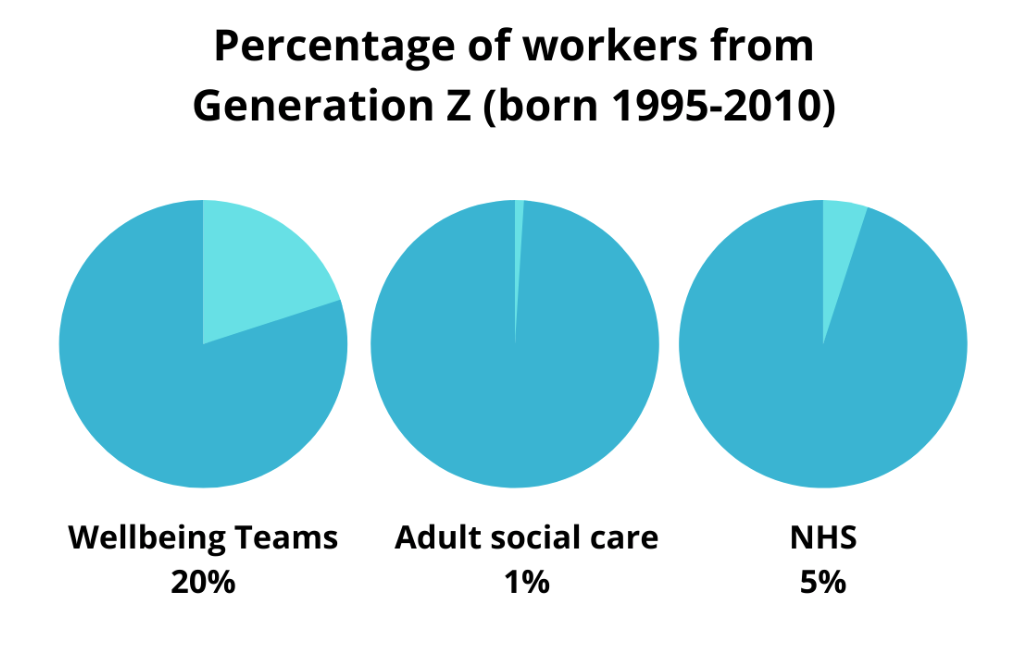
Four weeks after that recruitment workshop we had our first team of six Wellbeing Workers start their induction with us. Over 60% of our team members have never worked in health or care before. We also recruit a higher proportion of younger people in Wellbeing Teams compared to the NHS and Adult Social Care. The photos are from our first team in Wigan.
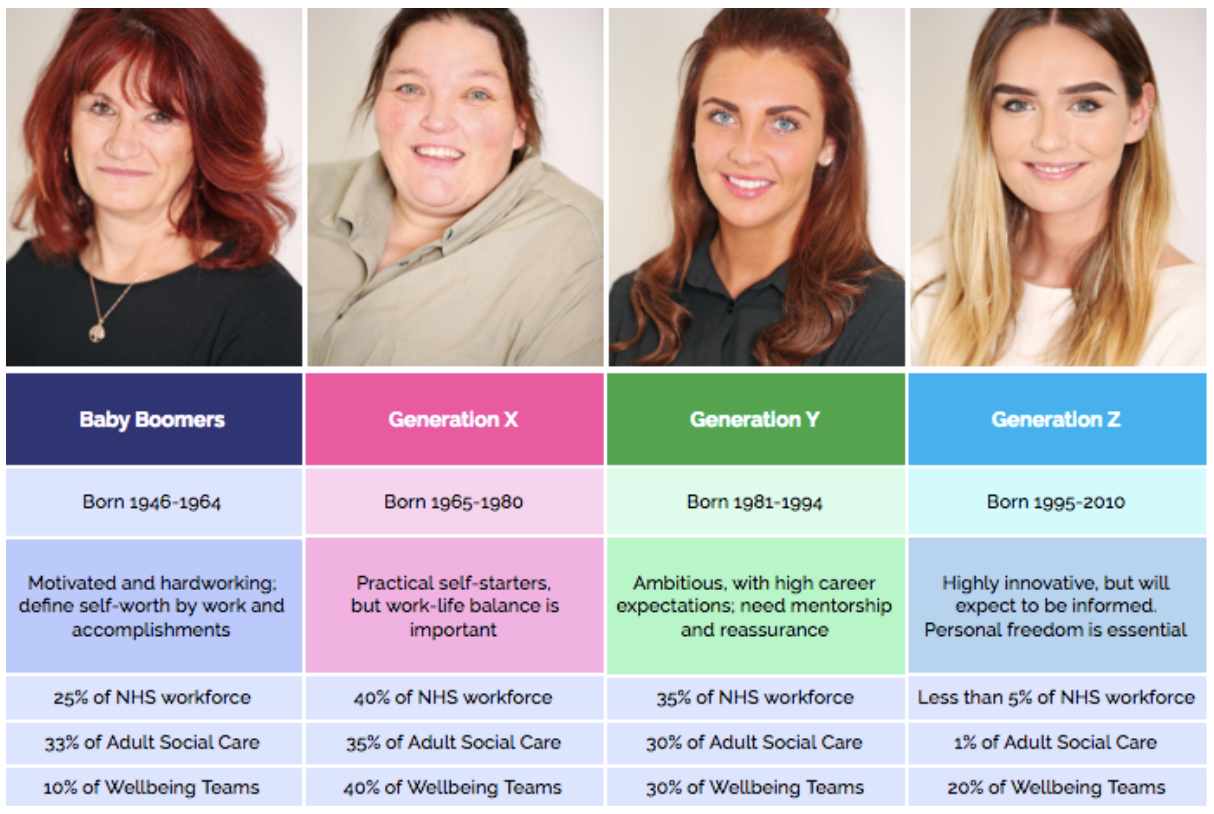
I am not sure whether it is the recruitment process or the attraction of self-management that brings younger people to Wellbeing Teams.
The early indications from the Wellbeing Teams in Thurrock Council suggests that Wellbeing teams have five times the retention rate compared to traditional home care, and one third of the sickness rate. It was based on two teams, so a small sample, but still encouraging findings.
If I am honest, I am still holding my breath just a little with each new recruitment process. At our team meeting yesterday, Michelle reported that there had been 101 people we had invited to have a first conversation with, leading to two on-line workshops next week for the latest teams, recruited in partnership with a local council. After nearly three years of being a provider we are now working in partnership with councils and providers to recruit their own Wellbeing Teams or use these approaches. Everyone in recruitment, as Jackie Le Fevre says, is doing values-based recruitment. The question is whether you are doing it consciously and intentionally.
Format: Blogs
Tags: Self-Management , Values , Radical HR , Rehumanising Work
Comments
No comments on this post yet.