
.png)
The Relational Universe - using metaphor to visualise a person’s life as a system
By Nicole Ashworth, Gabriel Eichsteller & Lowis Charfe
It is frequently acknowledged that relationships are crucial to the support we provide in social care. But all too often, the focus in relationship-based practice is predominantly on the one-to-one relationship between us as the professional and the person we support - with the implication that this relationship provides us with a means to achieving a certain outcome in the service user’s life. There are two issues with this from a Human Learning Systems perspective: firstly, whilst critical in order for us to gain an insight into a person’s life and the issues they’re experiencing, relationships must be more than just a means to an end. If we instrumentalise relationships, we limit the encounter between us as human beings and the positive power of meaningful relationships, reducing them to little more than a useful tool. Secondly, in addition to trivialising relationships, this approach fails to grasp how outcomes are achieved and who is responsible. From a systems perspective, outcomes are not created by a single entity but by the complex interplay of the actors and factors that are part of someone’s life. Thus, a person with substance misuse issues might benefit from going through rehab and kick the habit whilst in the treatment centre. But if they’re simply returning to their previous social environment, in the same deprived community, with the same lack of opportunities to turn their life around and find meaningful belonging, then most factors in their lifeworld remain largely unchanged. The odds are stacked against the person being able to maintain the positive life changes without supportive relationships.
We therefore need an approach that helps identify the ‘system of interest’ to the individual - the web of relationships and connected factors - that can create better and more sustainable outcomes in the person’s life. This is where the Relational Universe (Carter & Eichsteller, 2017) can play a valuable role. Combining systems thinking with the use of metaphors, the model illustrates relationship-centred practice and highlights the fact that as human beings we are all interdependent and interconnected - a crucial difference to much social work practice that focuses largely on independence. The Relational Universe visualises the diversity of relationships each person has – with family members, friends, professionals (e.g. in education, health, social care), and community members. Each of these relationships forms part of a universe that’s in motion and constantly evolving, with important qualitative differences in how close or distant, rewarding or challenging, temporary or long-lasting, important or insignificant the relationships are and how much “gravitational pull” they have.
Our role as professionals, therefore, goes far beyond building trusting relationships with the people we support – it encompasses a duty to support people in cultivating their Relational Universe by developing more positive and meaningful relationships with those people who are important in their lives. This means we must seek to understand the person’s Relational Universe and what makes relationships meaningful from their unique perspective, without being judgmental or manipulative about relationships we consider problematic. We must remember that, for most people, being in a toxic relationship is still preferable to having no relationships at all. We do not get to decide who is or is not part of someone else’s Relational Universe and has a ‘gravitational pull’ on them, either physically or emotionally. Our role is more educational and dialogical, designed to enable people to recognise the power dynamics at play in relationships, experience what trusting and positive relationships are, and enjoy a sense of equilibrium within their Relational Universe. We therefore need to look for both the inherent and potential value of every relationship within a person’s universe, how we can help bring out the best in these relationships and thus strengthen people’s interdependence.
The below example written by social worker Nicole Ashworth shows the imaginative ways in which the metaphor of the Relational Universe can be extended and how it can help illuminate the different relationships that are important in someone’s life:
Having been introduced to the concept of the Relational Universe on a course facilitated by ThemPra and Ali Gardner, I chose to draw the universe of someone I have recently supported. For the purpose of the activity, I called her Marie, which is not her real name. Marie has experienced abusive relationships which have led to long-standing problems with drinking alcohol to excess.
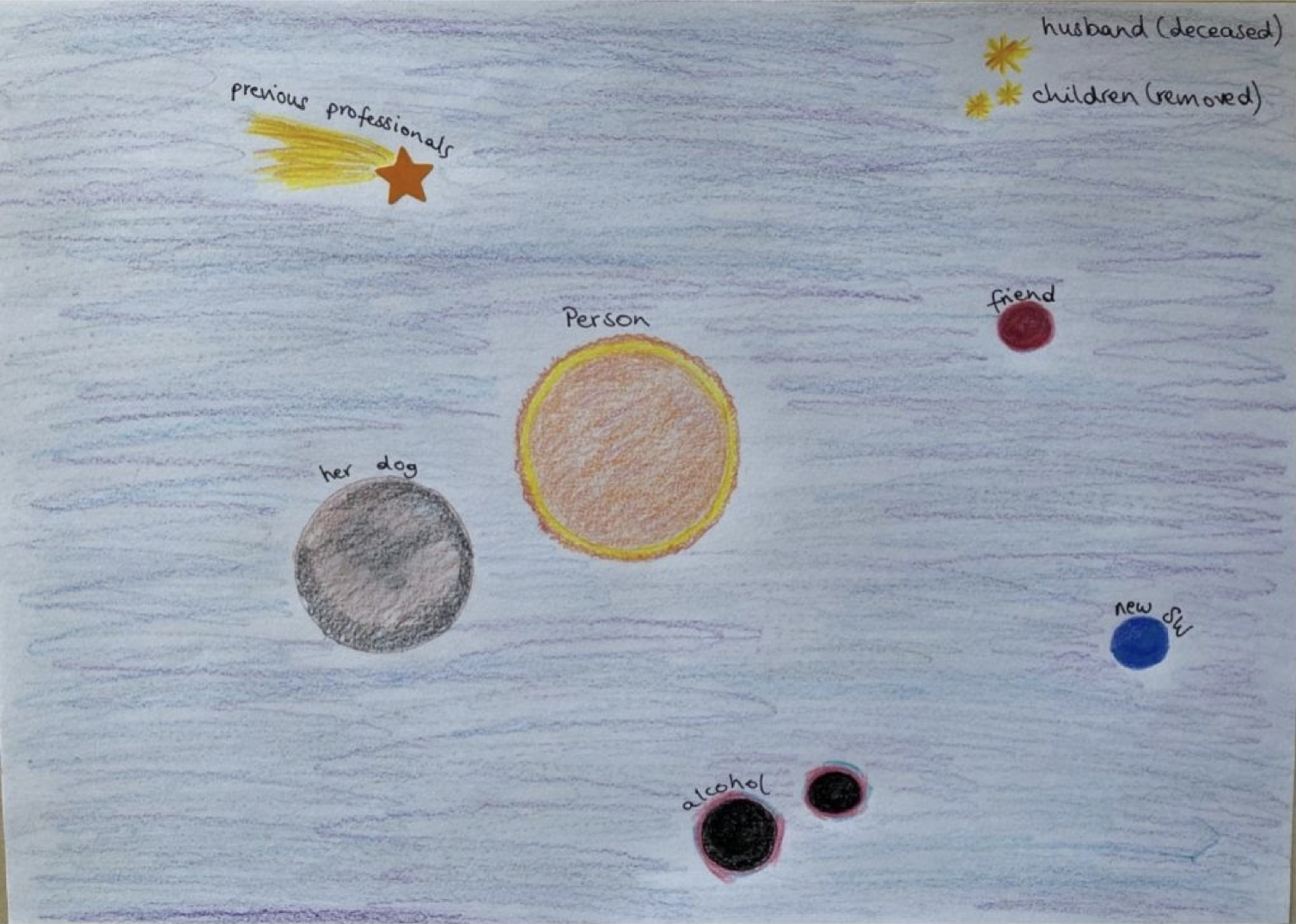
In Marie’s universe, I placed her at the centre as the glowing force in this. She can be fiery at times, but also she is naturally the central focal point. Marie lives on her own. Her husband passed away years ago, and their children were removed when they were young. I depicted them as stars in the distance. Whilst they are no longer physically there, they continue to shine for Marie in her memories. Marie’s most important factor in her life is her dog, which I drew close to her. A little further along in the constellation is her friend, who I imagined as a small red planet. The reason why I chose red, an alarming colour, is because her friend has her own issues, and she and Marie can negatively influence each other. They appear to have a symbiotic relationship (although it is not for me to judge this). Marie would have probably not chosen red to describe her friend! Further down in the universe, there are two black holes which represent the alcohol. They have a strong pull on Marie and influence her a lot. In the left hand corner we have a beautiful, sparkling and rare shooting star. The shooting star in Marie’s universe stands for previous professionals who were involved in her life, and there were lots of them! Initially they were keen to support her, but Marie finds it difficult to build and maintain relationships. She easily withdraws her engagement. So, these shooting stars appear in her life or “knock on her door” and, as quickly as they appear, they disappear again; if you blink you miss them. Shooting stars are seen as something amazing and rare, something you're lucky to have seen. People make a wish and wait for it to come true. How many times did Marie wish for someone to come along and understand her? And I don’t mean: “Yeah, I totally get you. Let’s get you sorted!” No, what I mean is for professionals to use their empathy to fully explore Marie’s feelings and thoughts and her reasons for non-engagement with professionals. The new social worker is depicted as a small blue planet, almost blending into the background and sitting on the periphery for now, until Marie invites them to move closer into her universe's constellation.
I found the concept of the “Relational Universe” extremely valuable in order to explore relationships. It really made think about how I perceive the relationships someone has, and how the person, in this case Marie, would view them. I have no doubt that she would have had a very different constellation of planets and forces if she would have drawn her own universe. As professionals, we sometimes want to feel as if we are the most important person in someone’s life, as we want to be the agents of change. However, looking at our own universe, do we perceive our GP or dentist to be a big influencing factor in our lives? Of course not, they are metaphorically on a different planet! This concept really helped me to analyse relationships more deeply, and it acts as a stark reminder of how privileged we are to be part of someone’s universe.
The Relational Universe can also serve as a valuable metaphor for how we understand interprofessional practice and our own interconnectedness with colleagues, other teams, other organisations, and the (local) communities we serve. This idea is exemplified in the Lighthouse case study, which addresses the process of setting up a children’s home in South London. From the outset, the team has focused on becoming part of the local community, introducing themselves to neighbours and other professionals, using local tradesmen, and developing close relationships with key institutions in the community to actively support the home’s social and structural inclusion.
This shows the potential when we expand the Relational Universe metaphor to us as professionals, too, and explore ways in which we can create greater equilibrium in the relationships with the people that are part of our professional Relational Universe – whether we like their presence or not. In this way, the Relational Universe can guide us in taking a systems perspective to how we work relationally within HLS both with the people we support and with other actors that form part of the “system of interest” in the lives of the people and communities we serve.
Nicole Ashworth is a social worker, ASYE and Student Lead with Middlesbrough Council; Gabriel Eichsteller is a co-director and learning facilitator with ThemPra Social Pedagogy CIC; Lowis Charfe is a senior lecturer with the University of Central Lancashire and course leader for the MA in Social Pedagogy Leadership.
Format: Blogs
Tags: Human Learning Systems , Understanding Variety , Rehumanising Work
Comments
jv
great article! thanks for sharing
Reply to this comment