
.png)
Human Learning Systems - Implications for Workforce Development: Insights and examples from Wellbeing Teams
Wellbeing Teams started with reflections on a significant birthday. My Dad died when he was 53. As I approached my 50th year I started to ask myself, “If, like my Dad, I only had three years left to live, would I still want to do the work that I am doing now?” The book Reinventing Organizations by Frederic Laloux helped me answer that question. It introduced me to how organisations are evolving, and that the leading organisations of the future, called teal organisations, will have 3 things in common – bringing the whole self to work, focus on purpose, and self-management. Immediately I wanted to make that change, and to evolve as a team. I was CEO of a H S A, a small, international, health and care consultancy team, and the book led us to become a self-managed team. I stepped down from being CEO and over the next two years we learned how to self-manage. One of the examples in Laloux’s book is the self-managed organisation of nurses called Buurtzorg, in the Netherlands. It employs over 12,000 nurses, who all work in self-managing teams of now more than 12 people, supported by a coach. There are no managers. They have a small HQ of around 40 people with no director of finance, no HR director, no marketing team. Against all measures of success they are highly successful. Inspired by Buurtzorg I set up Wellbeing Teams, as a provider organisation, registered with CQC to deliver home care. Wellbeing Teams are small, neighbourhood self-managing teams, delivering health and care support. The purpose of Wellbeing Teams is to support people to live well at home and be part of their community. We delivered support through teams in the North West, the Midlands and the South for three years. We were the first self-managing organisation in social care to be registered and inspected by CQC, and went on to be awarded ‘Outstanding’ by CQC in our first inspection. This is something that less than four percent of providers in home care achieve in their first inspection. We used Value-Based recruitment to attract and recruit from outside of health and care. This resulted in 80% of our team members coming from outside of home care and 60% had never worked in health or care before. The churn in homecare, where carers move from one organisation to another is significant. Therefore most providers recruit to and rely on people coming to them with experience. As we recruited people who did not have health and care experience, and as self-managing teams, we needed to create an approach that enabled people to live our values in the way they delivered support, and quickly feel confident and be competent. There are seven key elements to how we worked with the teams to support them to learn, develop and grow. In this blog I will give practical examples of each of these areas, they are:
- Clarifying Capacities and Behaviours associated with Values
- New ways to learn and demonstrate competence and confidence in induction and probation
- Using the Learning Sequence to meet performance outcomes
- Bringing your whole self to work to learn and grow
- Virtual Learning Help desk and proactive learning opportunities
- Seeing day-to-day work as an opportunity to develop, learn and grow.
- Learning and Development Budget held by each team.
1. What do we need to deliver our values and purpose? Rethinking policies, capacities and behaviours.
How can we deliver our purpose and live our values? Wellbeing Teams have 6 values and we clarified the behaviours you would expect to see when we are fully living our values. We spent time looking at policies, procedures and processes needed to achieve our purpose. Registering with CQC and having contracts with local authorities requires a raft of policies and procedures. We started by taking a fresh look at policies and procedures in practice and the link to learning and development.
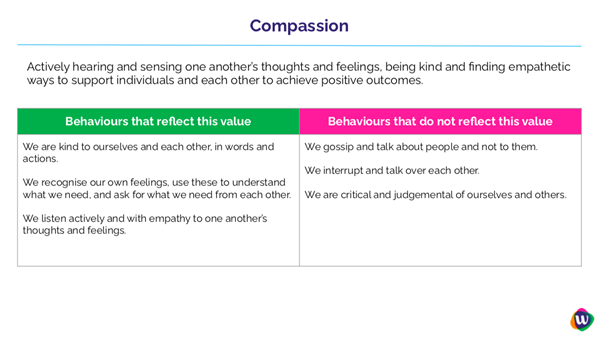
We worked with values expert Jackie Le Fevre to define our values. We used the value definitions from the Minessence Values framework. Here are our values and what they mean to us: Compassion means actively hearing and sensing others’ thoughts and feelings, being kind, and finding empathetic ways to support individuals and each other to achieve positive outcomes. Responsibility means initiating ways of working that dignify everyone at the same time as holding self and others accountable for actions and attitudes in relation to our shared purpose and values. Collaboration means cooperating with others by sharing ideas and insights to find ways we can both individually and collectively achieve positive change. Curiosity means feeling energised by discovering new insights, learning, finding answers to questions and wondering at the world. Creativity means exercising the capacity and ingenuity to respond appropriately to seize opportunities without needing to be directed or instructed by others. Flourishing means creating the conditions for thriving that reflect aspirations, remove barriers to connection, and ensure people choose their own way forward. Brene Brown made me realise that having a shiny list of values is not enough - even a list with clear descriptions. For each of our values we specify the behaviours that we would expect to see and what behaviours sit outside of our values. Here is an example from our first value of Compassion. The behaviours that reflect this value are integrated into the Progress self-assessment (explained later in this blog). We have a self-assessment for new colleagues that we use in induction and probation to support team members to know what we are looking for in behaviours and performance.
b) Rethinking policies, procedures and learning
Typically, organisations create a huge range of policies and procedures, as required by local authorities and CQC, or pay an organisation to create them for them. When you join an organisation, you are likely to be given these policies and procedures and asked to sign that you have read them. All 150 plus pages. This covers the back of the organisation if something goes wrong,because they can claim that you did not comply with the policies and procedures that you read during the first week. Policies and procedures and combined, and contain both what you need to know as well as what you need to do. Policies and procedures are usually the domain of the HR department, and any changes need specific processes to agree them, or alternatively cannot be changed locally as they have been bought from an organisation who updates them. This means that procedures - how we work - cannot change without a usually lengthy process of approval. Therefore either everyone is following the set procedures, and there are no opportunities to experiment and improve on them, or people are informally improving and changing them, but this is not recorded and the procedures are therefore not up to date with practice. A Human Learning System requires a different approach. In Wellbeing Teams separate policies, from procedures and capabilities, and how we can learn in relation to them.
- We have only a few pages of policies.Each policy is a statement of what needs to happen, that relates to our purpose and values, and reflects what is required by the regulator. For example, in relation to safeguarding, the policy would be that we keep people safe from harm.
- This is what people need to do to deliver our policy, and live our values, to achieve our purpose. For example In relation to safeguarding, this is what we want team members to do to prevent harm, and how we want people to respond when they find that harm has happened. We have a small, green ‘How We Work’ booklet that is 47 pages (around 20 pages of A4). People keep this with them to refer to if they need to. This is supplemented by apps on safeguarding.
- What do people need to know or do to be able to work in the way we describe (follow procedures) and how can we all feel confident that people are able to do this? We use ‘What if’ cards and confidence scaling here (described later in this blog). ‘What if’ cards are scenarios that help team members reflect on how they would implement our policies, and our procedures, and reflect our values. For example, in relation to safeguarding, what if a card says: “A family member contacted you to say her mum had lost a gold ring and was blaming a team member (concern about financial abuse)?”
What would you do? How confident do you feel in handling this? We think the best way to know whether people have understood what they need to know at the end of induction isn’t signing that they've read policies and procedures, but doing a multi-choice test so we can be sure that people, for example, know what the ten kinds of safeguarding and potential abuse are.
- Learning: How can we keep improving how we work to deliver our policy (and therefore live our values and work towards our purpose). To learn we use real life - what happens as we support people, both when things go wrong, and when we exceed expectations. This learning is reviewed at a monthly team meeting when we review compliments, any accidents or incidents and enquire about what that means for how we can improve. This could lead to:
- A new What If card if we don’t have this issue fully covered in the way we would like.
- An experiment to improve a procedure/how we work. If this is successful we would look at extending the experiment to other teams, and then review the experiments and make a change to our procedure.
- After experiments, any suggested change to a procedure is made through a Governance Process as it would have implications for all teams, not just the team who was experimenting.
c) Capabilities - clean in, through and out for key procedures
We worked with Andy Brogan from Easier Inc to think about our capabilities, or what we needed to be great at to deliver on our purpose, policies and values. We did that at a high level, and then for core competencies we looked at what capabilities were needed by team members, Wellbeing Leaders and the National Team. Andy introduced us to the concept of ‘clean in, clean through and clean out’ so that we could describe what needed to be done before, during and after a procedure, for example, before, during and after an initial conversation (our version of an assessment). We also looked at what reflective questions (known as Confirmation Practices) would be helpful for people to review their practice after the task was completed. We decided on the roles that would be needed in a team to deliver the expectations of self-management. We put this alongside the expectations of the regulators, CQC, in relation to processes, learning and development, and this included thinking about the Care Certificate. The Care Certificate is the standard and expected way that team members learn and demonstrate their competence. This was useful, but did not fully align with the capacities that we wanted team members to have, so we extended and developed it to become the Wellbeing Teams Certificate of Care. We also developed our ‘Progress’ self-assessments so that team members could know what good looks like for each procedure or role, and be able to rate themselves on a scale of 1 - 5 for each of these. The Progress self-assessments are used in induction and probation, and specify where team members need to be at the end of probation. Describing our values in relation to expected behaviours, and going from purpose to policies, processes and procedures were the foundation of the approach we have taken to learning, growth and development. Next we look at how to enable team members to develop their competence and confidence in delivering them, starting with induction and probation.
2. New ways to learn and demonstrate competence and confidence in induction and probation
Jane Hart (Modern Workforce Learning, 2021) is compelling about the need to focus on performance outcomes and not learning outcomes. What matters is the difference that the learning makes to how we work, not just that we learn. We want Wellbeing Workers, who usually have never worked in care before, to be both competent and confident in their role. To achieve this we focussed on being clear about what is expected so that team members can assess their own progress and ask for what they need, and where they need to be at the end of probation. The process we use is the Progress self-assessment. The role of a Wellbeing Worker (and most roles!) cannot predict exactly what will happen, so we also wanted to focus on confidence in dealing with the expected and unexpected. This helps us to see how confident team members feel applying our values and policies to different situations that emerge, and following procedures in a range of different circumstances. Part of building confidence and addressing new situations (and when things have gone wrong) is looking at different scenarios and how we apply our values and policies in different situations. We use ‘What if’ cards and confidence scaling to help. The multi-choice at the end of induction helps us learn whether people have the content information they need. Confidence scaling and What if cards help people reflect on how they can apply this learning and perform. From this we can then co-design personalised learning focussed on the areas people are least confident in.
a) Coaching
When a new team member joins us we have a Practice Coach (or very experienced team member) provide support and ‘on the job’ training. This is usually for around 26 hours.
b) ‘Progress’ Self-assessment and the ‘on track, off track board’
The Progress self-assessment is the golden thread from the role description to the day-to day-work. The self-assessment describes what good looks like for each element of the role, self-management, and living our values. We start using it at the beginning of induction and invite people to complete it. As we teach people the skills that they need, for example, moving and handling, food hygiene, etc, we ask them to update their scores. During the probation period (6 months) at each team meeting we ask new team members to use our ‘On Track/off track’ board to reflect their progress. There are 3 columns - on track, off track and way off track. We ask them to put their name on a sticky and put this where they think they are in relation to progress towards the end of their probation (based on their Progress scores). This is critical. Rather than having a manager assess progress, we live our value of responsibility by asking team members to take responsibility for how they are doing, and then to ask for what they need in the team meeting if they need more help or support in progressing (this is where we use the Learning Sequence described later in this blog). Team members have to demonstrate their competence to the Wellbeing Leader who ‘signs them off’ at the end of probation.
At the end of induction we use an online survey with the team to help them think about how confident they feel in relation to key elements of the role. They rate themselves on a scale of 1 - 5. The Wellbeing Leader then works with any team member who is concerned about their confidence to co-create a bespoke ‘programme’ in relation to the areas that the person lacks confidence. This broadly follows the Learning Sequence (described below) and is likely to include working alongside an experienced team member in key areas. Magda was a new Wellbeing Worker who had a disability and arthritis in her hands. At the team meeting she marked herself as ‘off track’ and explained that although she had been supported to use PPE, it was still taking her too long (by her standards) to use gloves and some specific health equipment with one of the people she supported, Mr Timms. The team problem-solved with her (using the principles of the Learning Sequence) and the decision was to ask the District Nurse, who Magda works alongside to support Mr Timms. The District Nurse was able to share some specific tips with Magda that enabled her to feel more confident in using PPE and the health equipment.
What if cards are central to our approach to Learning and Development. We have two sets, a value based set and a practice set. The practice set are short scenarios that ask people what they would do if something - a particular scenario - happened. They are based on actual experiences in Wellbeing Teams, as well as reflecting each policy and procedure. We start using them in recruitment, as a way to both give people a flavour of the role and to see how people apply common sense in approaching situations. The values set invites us to reflect on situations in relation to our values. Each month, when the team reviews any incidents, accidents, complaints and compliments, we ask whether this issue is covered by existing What if cards or whether we need to generate a new one that reflects the issue that emerged. This way our deck of cards grows in line with our experience. New What if cards are used in teams during team meetings to help each team member reflect and feel confident in what they would do if this situation arose. We use the Learning Sequence (below) to help team members personalise elements of their induction and probation where they need more help, and in progress and learning overall. Let's look at this next:

3. The Learning Sequence
The Learning Sequence is a way to think creatively about how you can achieve your learning, growth or performance goals. It is an adaptation of the Support Sequence (H S A/Wellbeing Teams 2020) that we use to help generate options for people we support to achieve their outcomes. We start with a clear outcome framed as a change in performance. It starts by asking people to reflect on what they have tried already, and then the Learning Sequence helps generate ideas and options to achieve the change you are looking for. The Learning Sequence is:
- Yourself What can you do to achieve your performance outcome? How can you build in time to practice? How can you be accountable to yourself and others for your progress?
- Technology Is there any technology that can support you to achieve performance outcome? Are there Apps that help you? YouTube? On-line learning programmes?
- Equipment and Adaptations Are there any products or equipment that could help? Are there any physical changes that could be made to your workplace that would help?
- Team, family, friends and neighbours Do you know anyone who has this skill or who has achieved this outcome who can support you? Is there someone who can be an accountability partner to help you keep on track?
- Community Are there places, people or events in the local community or on-line communities that could help?
- Services Are there learning providers (who provide courses) who can help you achieve your learning outcome?
- Support Do you need to pay for coaching or other personalised support to help achieve your learning outcome?
Below is an example of how it can be used in relation to speaking up at meetings.
| Example: Raising tensions in meetings. Being able to raise tensions in team meetings is a self-management competence that we support and expect team members to achieve in their probation. Here is an example of using the Learning Sequence with a team member who thought she was ‘off track’ in her confidence and skills in speaking up in meetings and raising tensions. What have you tried already? Seeing if I have any issues or tensions to raise at team meetings. I usually can’t think of any, but if I do I am never sure how to bring it up. I know that Compassionate Communication could help me with asking for what I need but I don’t feel very confident with this yet. I forget that tensions are about how we can improve, not just things that are getting in the way. | |
| Yourself What can you do to achieve your learning outcome? How can you build in time to practice? How can you be accountable to yourself and others for your progress? | During the week I can make notes about possible tensions rather than waiting until the day of the meeting to see if I have any. |
| Technology Is there any technology that can support you to achieve your learning outcome? Are there Apps that help you? You Tube? On-line learning programmes? | Use an App to make a note of potential tensions. I always have my phone with me, but don’t usually have a pen and paper. I could use the note taking app. Michelle gave us a link to a YouTube clip about tactical meetings. I want to go and watch that again. Have a note on the app that reminds me that tensions can be about improvements, not just what is getting in the way. Emily shared some links to YouTube films about Compassionate Communication that could help. There is a Mood Meter App that Emily mentioned, I could download that and try using it. |
| Equipment and Adaptations Are there any products or equipment that could help? Are there any physical changes that could be made to your workplace that would help? | I have lost my ‘Feelings and Needs’ card from induction. I could ask for another laminated copy to look at to prepare for the meeting so I can feel more prepared by looking at my feelings and needs. |
| Family, friends, neighbours, team Do you know anyone who has this skill or who has achieved this outcome who can support you? Is there someone who can be an accountability partner to help you keep on track? | I could talk to my buddy about helping me by being an accountability partner about raising issues at a team meeting. I will be more likely to do it if I know I have to check in with her before and after the meeting. I could ask the team coach to help me understand what is getting in the way of speaking up in meetings. I think I am worried about getting it wrong because it is a new way of working for me. |
| Community Are there places, people are events in the local community or on-line communities that could help? | I could google to see what on-line communities there are around Compassionate Communication and see if there are any that Emily particularly recommends. |
| Services Are there learning providers (who provide courses) who can help you achieve your learning outcome? | I don’t think so. |
| Support Do you need to pay for coaching or other personalised paid support to help achieve your learning outcome? | I don’t think I need this. |
| Decision: To achieve my performance goal of raising tensions in meetings I will get another copy of the feelings and needs chart, use an app to record possible tensions during the week, and ask my buddy to be my accountability partner. If I am still not raising a tension at meetings, then I will ask for a session with the team coach to see what is getting in the way. How will you see a change in my performance? I will self-assess my performance and I want to move from 2 to 4 on ‘Progress’. My buddy will see me raising a tension at most meetings (two out of 4 at a minimum). | |
Being confident and competent at delivering support and in self-management is part of learning and development in Wellbeing Teams. Now we move to growth - and how we encourage and support team members to bring their whole selves to work and grow and develop as people, not just career aspirations.
4. Bringing your whole self to work to learn and grow
We start our focus on bringing your whole self to work in recruitment, asking people to develop and share one-page profiles. A one-page profile has three sections, what people appreciate about you (strengths, characteristics), what matters to you and what support you need to do your best work. In induction we build on this and extend it to what matters to you: past (history maps), present (values, one-page profiles, gifts of the head, heart and hands, and wellbeing plans) and future (Future Focus).
We invite people to consider what experiences they want to have, how and where they want to grow and develop and to think about contributions. We encourage team members to think about what is practical and possible over the next one to three years, and then to narrow down and decide on their focus for the next six months to one year. Values: We start with values, so that we can reflect on what experiences, areas of growth and development and contributions would most align with personal values. Experiences: We invite people to consider the experiences they would like to have over the next year. This may be ‘bucket list’ type experiences, for example travelling to a particular place, trying something new. Growth: This reflects areas that the person wants to grow and develop. It could involve developing skills, behaviours or personal development. Contribution: One of the 5 Ways to Wellbeing is ‘give’. We invite people to think about ways that they want to contribute to the lives of others, the community or the environment. This could focus on their work as a Wellbeing Worker, or volunteering and contributing in other ways. Once people have a list in each area, we invite them to think about what they specifically want to focus on over the next 6 months, and set an intention around that, and share it with their buddy. The buddies agree how they will support and encourage each other to move towards that focus. We also invite people to think about the contributions they could make to Circles Connected, and create community opportunities with and for the people they support. We explore this further when we invite people to identify their gifts of the head, heart and hands as part of induction.
Wellbeing Action Plans bring together an approach we have been using in Helen Sanderson Associates called Stress and Support with the NEF evidence-based 5 Ways to Wellbeing. The 5 Ways to Wellbeing are: Stress and Support is a table which invites people to reflect on when they are likely to become stressed (what is happening), what others would see, what they themselves can do to relax or comfort themselves, and how they would like others to support them. When we are asking people to develop these in induction, we then ask people to check back to see if they need to add or update anything in their one-page profile in the ‘to be successful in supporting’ section, and whether they want to propose anything to be added or strengthened in team agreements. We then share the 5 Ways to Wellbeing as a wheel and ask people to rate each of the 5 elements on a scale of 1 - 10 (ten representing that there is no improvement possible in that area). We ask people to then choose the one or two areas that they want to develop and progress in, and work with their buddy to make that a specific goal. Bringing your whole self to work includes developing your whole self, not only work related behaviours and next steps in your career. We see this as a continuum on the ‘Know/Grow’ spectrum and you can learn more about it here.
5. Virtual Learning Help desk and proactive learning opportunities
Ben is our lead for Learning and Development. Part of his role is to work with Wellbeing Leaders to enable people to successfully pass probation. Once through probation, team members choose their own learning, development and wellbeing goals as described in the earlier section. Ben offered a ‘Virtual Help Desk’ for people, providing coaching, information and advice on the learning opportunities related to the learning or performance outcome. He uses the Learning Sequence to do this. The ideas would rarely be a traditional course and could include TED Talks, short courses on Udemy, books, blogs or podcasts and offering a book club, or a community of practice, linking to an internal champion for that area. We have champions for different areas of our work, for example, mental health in the workplace and end of life care. They have separate WhatsApp groups, Coproduction Partners and external experts. For example, the End of Life group has a Death Doula, someone who is training to be a funeral celebrant and is supporting us to host a Death Cafe, two champions and our Co Production Partner. As well as responding to requests, we see the role of Learning and Development lead as pro-actively offering curated learning opportunities, to enable individuals and teams to grow and develop. Here are examples:
- Compassionate Communication Practice Group - Emily is providing learning opportunities to develop skills in Compassionate Communication. After covering the basics in induction, the opportunities are to go deeper with an e-learning programme, and then practice through ‘empathic listening practice’ in pairs, sharing information about what is available (eg a NVC Fit programme) and hosting a monthly Compassionate Communication practice club.
- Book clubs - there is a monthly book club based on a curated series of books that reflect elements of self-management. In the Wigan Wellbeing Team, the first book club was on ‘FISH’ about creating a culture where people are present, have fun, choose their attitude and make people's day.
- Monthly themes - Each month there is a theme around health and wellbeing, covering issues around our support and the team’s own wellbeing. The teams decided on the most important themes that they want to do and the themes also reflect areas that we want to improve in (perhaps as a result of our review on incidents or Peakon Scores).We then work with our National Advisors (e.g. Dr Rod Kersh in relation to information to share with the team). Depending on the theme, this may be explored in buddy sessions or in team meetings or directly with people we support in their monthly check-ins.
These proactive opportunities for learning are important, however the work itself, the day to day support provided is one of the most important ways to keep developing and improving, both individually and as a team.
6. Seeing day-to-day work as an opportunity to develop, learn and grow.
As far as possible we focus on the day-to-day work being an important way for us to learn how we need to improve, and develop and practice new skills. We reflect and learn about how we are delivering in our roles through Confirmation Practices, and through an analysis of what is going well (compliments) and where things are not going as they should (complaints, incidents and accidents). This is alongside ways to check in with the people we support, their families, and using person-centred team reviews. We use the workplace to learn through Team 15s, What if cards, our monthly themes, and feedback and coaching.
a) Confirmation Practices
Andy Brogan introduced us to Confirmation Practices. There are different ways to use Confirmation Practices, and we use them to reflect on roles every 2 weeks as part of team meetings (for Wellbeing Workers and the national team), and to reflect on our Team Agreements every 4 months. The role Confirmation Practices are a list of statements that relate to the person’s role, and link these to our values. The person rates themselves between 1 and 5 on how well they think they are doing in relation to the role, and why they have given themselves that score. When we use them in meetings, buddies coach each other to review scores and to think about what they want to commit to changing over the next two weeks. We post these intentions/goals in our Slack channel called #IWILL, so that we can all see each others’ commitments and can support and encourage each other. These are one of the strategies that replace supervision in a Wellbeing Team. Below are the Confirmation Practices used within Wellbeing Teams, and how they support us to live our values. 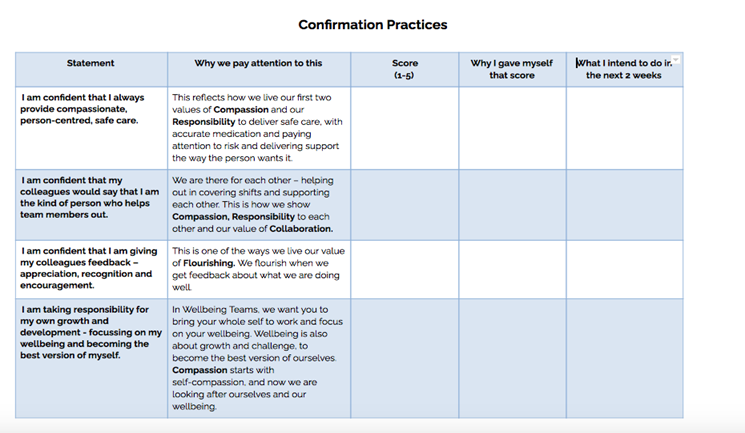
b) Monthly review of metrics, compliments, complaints, incidents and accidents
Once a month, each Wellbeing Team reviews that month's metrics, and the content of any compliments, complaints, incidents and accidents. As we described earlier in this blog, we use these to learn about how we can improve, what we may need to learn and change collectively or individually and this can lead to using the Learning Sequence, developing new What if cards or experiments.
c) Team 15, What if Cards, Monthly themes
We take 15 minutes in team meetings each month to either use a Team 15 (an exercise that helps us develop in 15 minutes), share our responses to a new What If card or the exercises or reflections based on the monthly theme.
We talk about giving feedback (and receiving it) from recruitment onwards. We see feedback as a gift, as a way to help us grow and learn. Each team member has a buddy who provides support and challenge. We expect Wellbeing Leaders to also be spotting opportunities for appreciation and feedback, and coaching team members based on what they see written on Slack, in meetings that they may attend, and when they are shadowing team members. One of our values is responsibility, and Confirmation Practices enable us to reflect on how we are delivering our role and where we can improve. Teams learn and develop through an analysis each month of where we are working well and what could be better. This leads to experiments, new What if Cards or opportunities for using The Learning Sequence and learning together in team meetings.
7. Learning and Development Budget held by each team.
The team has a Development and Learning budget available to support their development. One example is around someone we support who we will call Erica. Something that mattered to Erica is looking her best, and this includes having her ‘nails done’. This was raised at a team meeting, and as a result of this, we developed a Pamper Packs of nail varnishes, hand and foot cream for team members to use. We paid for training for team members to learn how to paint nails, and do scalp massage and foot massage from the Learning and Development budget.
Conclusion
Wellbeing Teams have or are supporting older people at home, families, people at end of life, and people living in Extra Care. Early indications from a two year evaluation suggest that, compared with traditional homecare, Wellbeing Teams have:
- One third of the sickness rate
- Five times the retention level of team members
- And if you were supported by a Wellbeing Team you were five times less likely to go to hospital.
We directly delivered services as a provider for three years, including through the early lockdowns and Covid. We learned that radical new ways of providing services, like Wellbeing Teams, need radical commissioning and system change. Now, we are introducing the principles and practices that we developed and used within Wellbeing Teams to councils and providers. The national Wellbeing Team is working in partnership with Councils to enable them to recruit their own teams based on Wellbeing Teams, and share what we learned more widely through programmes of support. Each new team is another opportunity to further test and refine these ideas, and experiment with new ideas and practices.
Format: Blogs
Tags: Self-Management , Human Learning Systems , Radical HR , Rehumanising Work
Comments
alex seed
Your article is great. I like to communicate with interesting people. I started using different services for my learning. I can check paper for plagiarism https://plagiarismsearch.com/plagiarism-check.html This is great for me.
Reply to this comment